Churches of Beshenkovichi Region: Places Worth Visiting

Religious tourism is a special type of travel aimed at studying religious traditions and the cultural heritage of a country, which goes beyond ordinary recreation and sightseeing. Journeys can be motivated by personal beliefs, a desire to strengthen faith, honor the memory of saints, or simply to touch upon the history and culture of different religions. Incidentally, January 2025 in Belarus was dedicated to this particular type of tourism.
Approximately 1400 religious sites are included in tourist routes across the republic. Of these, 400 are in the Brest region, 50 in the Gomel region, 460 in the Grodno region, 123 in the Minsk region, 69 in the Mogilev region, and 20 in Minsk. There is plenty to see here as well.
In Beshenkovichi District, there are 15 religious communities representing 3 denominations: Orthodox, Catholic, and Protestant. They own 14 places of worship, 2 of which belong to Catholic communities, 2 to Protestant communities, and all of them are operational. Orthodox communities own 10 places of worship, with only 7 currently in operation. 4 places of worship located within the district are included in the list of historical and cultural heritage of the Republic of Belarus.
St. Nicholas Church in the village of Dobrigory
The church was built in 1846 from wood on a brick foundation. It was restored and consecrated in 1999.
The temple is an architectural monument of the retrospective Russian style. Adjacent to the main square-plan volume are a two-tiered narthex-bell tower topped with a hipped roof and a cupola, and a low rectangular apse under a gable roof. The main volume is covered by a four-sloped roof with a cupola on a low, octagonal, hipped drum. The slopes of the bell tower's hipped roof are finished with triangular pediments at the base. The side facades are horizontally planked and feature high arched (main volume) and rectangular window openings.
Since 1856, a parish school operated at St. Nicholas Church, where the children of local peasants could learn to read and write.
The Church of St. Nicholas in the village of Dobrigory is the only wooden church of the 19th century in the Beshenkovichi district. It is a historical and cultural value of the Republic of Belarus of the 3rd category.
Ruins of the Church of St. Nicholas in the village of Slobodka
On the shore of Lake Svyatoye (Chernoye) in the village of Slobodka stands a church built in 1896 from red brick.
It is a cross-domed church with a high square main volume and four rectangular altar apses. The volume-spatial composition is dominated by a multi-tiered tented bell tower. The crossing is crowned with a bulbous dome on a faceted drum with a tent.
The facades are decorated with rustication, semi-columns, multi-profile cornices and belts, kokoshniks, etc.
The church was active until 1935. In its time, it was of great importance for the religious life of the parishioners of the deanery of the 2nd district of the Lepel uyezd, instilling moral and ethical norms of life in the peasant environment.
The church-parish school that existed at it contributed to the development of education in the region and the literacy of the population. Currently, the ruins of the Church of St. Nicholas are included in the State List of Historical and Cultural Heritage of the Republic of Belarus.
St. Elijah's Church in Beshenkovichi
The origin of the first shrine at this location is associated with the Polish King and Grand Duke of Lithuania Casimir IV, who, in memory of saving his wife from drowning on the day of the commemoration of the Prophet Elijah, ordered the founding of six Orthodox churches in Belarus. One of them was built in 1447 in Beshenkovichi.
It is documented that a new church, the Church of the Holy Prophet Elijah, was built in Beshenkovichi in 1870 through the efforts of Archpriest Joseph Nikonovich. Funds for its construction were allocated from the state treasury "with the aim of strengthening Orthodoxy in the region." No expense was spared, resulting in a magnificent cruciform dome church on a high foundation with thick red brick walls.
Having survived many historical cataclysms (the October Revolution, the Great Patriotic War), the church building has been preserved to this day and is a historical and cultural value of the Republic of Belarus, 3rd category.
The Holy Elijah Church is adorned with golden domes, a new handmade wooden iconostasis, and wall paintings. A Sunday school and a sisterhood operate at the church.
Holy Trinity Church in the agro-town of Ostrovno
In 1622, Alexander Dazhboh (Bogdan) Sapieha, Starosta of Orsha and Chechersk, in commemoration of the victorious return of the Lithuanian troops who participated in the Battle of Khotyn, built a Roman Catholic church and founded a Dominican monastery in the town of Ostrovno. In 1864, the church was transferred to the Orthodox diocese. In 1873, after reconstruction, the Holy Trinity Church began operating here.
During the Soviet era, the church was closed. From 1929 to 1937, the building was used as a warehouse, and then a bakery was opened in it. In 1941, during the German occupation, local residents repurposed the building for worship again, but in 1950, the church was closed. After some time, it reopened its doors to parishioners. Currently, reconstruction work is being completed in the church.
The Holy Trinity Church in the agro-town of Ostrovno is the oldest architectural monument in the territory of the Beshenkovichi district and is a historical and cultural value of the Republic of Belarus of the 3rd category.
Church of Saints Peter and Paul in Beshenkovichi
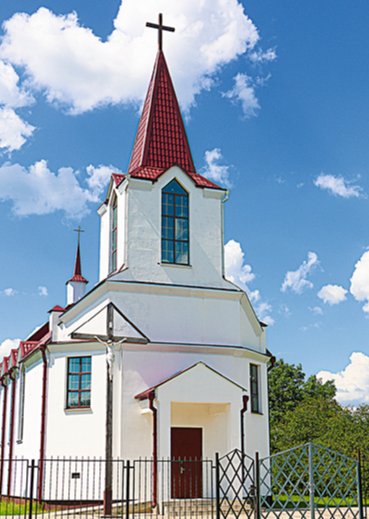
The predecessor of this church can be considered the Church of St. Casimir and Raphael.
The first Catholic church in honor of Saint Prince Casimir and Saint Archangel Raphael in the town of Beshenkovichi was built by Kazimierz Sapieha in 1650. The church was rebuilt after fires in 1785 and 1876. In the 1930s, it was closed. It was severely damaged during the Great Patriotic War.
In 2019, a new stone church in honor of Saints Peter and Paul was consecrated in Beshenkovichi, located in the center of the town.
Church of Saint Prince Alexander Nevsky in the village of Martinovo
On August 30, 1906, a rebuilt brick church in honor of Saint Right-Believing Prince Alexander Nevsky was consecrated in the village of Martinovo. The consecration was performed by the dean of the 3rd Lepel district, Antony Shivel'sky. The church was built of brick according to the design of I. F. Korshikov. It has features of classicism and pseudo-Russian style. Nikolai Turin was the first priest. A church-parish school operated at the church until 1917. The church building was severely damaged during the Great Patriotic War. The ruins of the church have survived to this day.
Holy Trinity Church in Ulla
In 1567, a fortress was built at the confluence of the Western Dvina and Ulla rivers by order of Russian Tsar Ivan IV the Terrible. During the war of 1654–1667 between Russia and the Polish-Lithuanian Commonwealth, the fortress was burned down, and in 1669, a wooden church named after the Holy Spirit was built in its place.
In 1864, a stone church named after Saint Luke was erected with the funds of Ignacy Reut. The result of the work was an interesting monument of classical architecture with symmetrical two-tiered towers, a sloping roof, and a triangular pediment. This is the temple depicted in the painting by the legendary traveler Napoleon Orda.
During the Great Patriotic War, the temple was severely damaged, but in 1999 it was restored and is still in operation today.
Church of the Holy Trinity in the agro-town of Ulla
The church was built in 1897 in the retro-Russian style with 35 thousand rubles in silver allocated by the state.
During the Great Patriotic War, when fierce battles were fought in Ulla, the temple was heavily damaged and remained in ruins for a long time. By 2010, the church was restored through the efforts of local parishioners. But years passed, and the shrine became dilapidated again… In 2021, by the blessing of the ruling bishop of the Vitebsk diocese, Archbishop Dmitry, the revival of the temple began anew.
The architecture of the temple embodies the features of the retro-Russian style. The composition of the church is based on a cruciform plan of the prayer hall, which is topped by a tent roof, representing a cascade of kokoshniks, with four small towers adorning its corners. In the center is a drum with a domed top. A two-tiered bell tower rises above the main entrance.